The following literature review were written for two of my favorite courses during graduate school at Dominican University: Dr. Janice Del Negro’s Library Materials for Young Adults course (2012) and Thom Barthelmess’ Library Materials for Children (2011).

Anderson, Laurie Halse. Speak. Puffin Books, 1999. Gr. 7-10
Something traumatic happened to Melinda at a party over the summer. This something dramatically changed her old friends into “ex-friends” and her social status to “outcast” just as freshman year of high school in Syracuse, New York begins. Melinda finds some solace in her lone friendship with Heather, the optimistic new girl from Ohio. But Melinda’s tough love parents and clueless teachers – save for the intuitive art teacher, Mr. Freeman – interpret her depression as delinquency. Anderson’s first novel for young adults employs caustic humor (e.g. “Fizz Ed”) and candor (e.g. “Overbearing Eurocentric Patriarchs”) to carefully balance the heavy weight of Melinda’s harrowing memory. The staccato rhythm of Anderson’s elegant prose (e.g. “My lips bleed a little. It tastes like metal. I need to sit down.”) and tight modern paragraphs give breath to the riveting emotional suspense. Anderson organizes the novel chronologically by the school year’s four marking periods. This structure keeps the reader close to the authentic reality of a contemporary, middle class American high school complete with bullies, jocks, cheerleaders, and an entourage of controversial school mascots. The well crafted reveal of Melinda’s trauma crescendos with her development as a visual artist. The prophetic references to Maya Angelou throughout the text speak to the parallel ways in which Melinda and Maya cope with childhood trauma (e.g. silence.) Speak is ripe for a dialogue on morality in a high school English literature course or public library book club as a stand alone novel or an interesting companion to Angelou’s I Know Why the Caged Bird Sings.

Angel, Ann.Janis Joplin: Rise Up Singing. Amulet Books, 2010. 13-18 yrs
Loyal band mate, Sam Andrews imparts a personal introduction to Ann Angel’s young adult biography on his friend and arguably, the first queen of rock and roll, Janis Joplin. Structured chronologically, Angel begins in Port Arthur, Texas where Joplin was a young adult struggling to conform to the social-cultural norms of the 1950s. Black and white photos, color photos, album covers, concert posters and contemporary multi-colored swirling borders embellish the wide pages and compliment the prose chronicling Joplin’s brief, twenty-seven years of life. The strong book design by Maria T. Middleton is achieved in part with the rich variance of images, extra spacing between the lines of text and spacious margins. This design makes Angel’s book accessible to a broad range of young adult readers as well as provides a strong emotional resonance to the subject.
The content is high interest to young adults interested in 1960s alternative culture and psychedelic rock and roll music. Angel smoothly confronts the taboo issues in Joplin’s late teen and adult years, such as alcohol abuse, drug addiction and sexuality in a matter-of-fact, non-sensational tone; “In the years to come, Janis would be more open to friends and lovers about her bisexuality.” Bullying, peer pressure and equal rights for women and girls are some of the themes a teacher or librarian could extract from the text and match with the right reader. Somewhat less well-known but still given light weight in Angel’s biography is Joplin’s ravenous intellectualism, articulated by Joplin’s friend Myra Friedman; “She was brilliant and very well read.” As an unconventional, pre-feminist movement role model for young adults, Joplin was also college and career-minded as a “savvy, hard-working business woman.”
The end papers contain a helpful time line, detailed notes and thorough bibliography ideal for the research paper writer or young fan hungry for more information. Young adults active in the Occupy movement can find support in Joplin’s words at Woodstock; “We don’t need a leader. We have each other.” More mainstream young adults with fashionable feather hair extensions can be pointed to the original feather-hair wearer by an attentive teacher or librarian armed with Janis Joplin: Rise Up Singing in hand.

Barry, Lynda Barry. What It Is. Drawn & Quarterly, 2008. Gr. 8-12
Calling all aspiring, stuck, professional, young and old artists, writers, dancers, musicians, actors and cartoonists, Lynda Barry wrote and illustrated this book for you. The non-fiction graphic novel begins in the neatly arranged hand-written reproduced note cards in the front matter and then dramatically opens with exquisite multi-media (e.g. watercolor, ink, fabric, newspaper and print clippings) full-page, full-color collages on a consistent background of yellow legal pad paper. Barry layers philosophical questions about image, imagination, and memory then smoothly transitions to autobiographical multi-panel comics. The broad subjects of her autobiographical writing detail her tumultuous childhood and redemptive college years at Evergreen State College. Looking back at her teen years, Barry notes drawing, writing, reading and music “made steady moods” and helped her survive the last three years of living at home with a verbally and emotionally abusive mother. Unusual to contemporary young adult literature, Barry addresses her occupation and the path she took (e.g. college) to becoming a professional cartoonist. The last quarter of the book provides the reader with creative writing and drawing exercises. The tone of Barry’s writing and illustrations is often humorous and tender. The enthusiasm of her writing during the exercise portion of the book is contagious. She affectionately eggs the reader on to write it, draw it – right now. Young adults will appreciate Barry’s honesty and her street credit as an old college friend of The Simpsons creator, “funklord USA Matt Groening” whom she thanks, along with her Evergreen State College professors, on the last page.

Block, Francesca Lia. Pink Smog: Becoming Weetzie Bat. HarperTeen, 2012. Gr. 8-12
Smog is gross, right? Not for thirteen-year-old Louise “Weetzie” Bat who finds consolation in the pretty, pink, polluted Los Angeles sunsets (e.g. “When the sun goes down and the sky flares it is really beautiful, like magic.”) This solace is needed after Weetzie’s dad (i.e. Charlie Bat) suddenly abandons Weetzie and her alcoholic mother. Block’s distinctive magical realism manifests itself early in the novel as an “angel” (i.e. Winter) swiftly arrives to rescue Weetzie’s mother from drowning. There are complications with Winter such as his Voodoo practicing sister, mysterious mother with a questionable past and their pack of vicious dogs. More pressing to Weetzie, how does Winter serve as a conduit to Charlie Bat? To heighten conflicts, junior high is just as painful as her home life. She is harassed by a pack of girl bullies and her two friends, both mutual victims of bullying, have their own coming of age issues to deal with (e.g. eating disorder and homosexuality.) Weetzie learns a life lesson to rely on her self and she provides great modeling on how to take care of one’s self in times of turmoil (e.g. taking yourself out for a date.) For Block fans, it goes without saying Pink Smog is the prequel to Block’s innovative Dangerous Angels series. For readers new to Block, Pink Smog can stand alone as a unique narrative featuring a young adult coping with her parents’ separation. Block’s signature whimsical and poetic style (e.g. “I could hear the whispers of the stars and smell their perfume.”) will create a pleasurable reading experience for quirky, artistic teens and young adults. Furthermore, tracking Block’s organic fairy tale and classic film references will offer an evocative literature discussion in a public library or classroom setting.

Bowman, Robin. It’s Complicated: The American Teenager. Umbrage Editions, 2007. 12-18 yrs
In 2002, photographer Robin Bowman hit the road to embark on a four-year quest to capture the “American Teenager” as s/he existed with “the excitement, openness, vulnerability, and idealism that infuse so many young people, regardless of circumstance.” Shooting with an old-fashioned Polaroid camera in the time before ubiquitous camera phones, allowed Bowman to instantly connect and collaborate with teens about how they wanted to appear on film. The trust Bowman gained through this artistic method allowed her to interview the teens about their lives after the “shared experience” of collaborating on the final shot. The result is a riveting collection of full-page black and white photographs accompanied by un-doctored statements made by the teens during their interviews, bound in a remarkable coffee table art book. The size and weight of the hardcover book makes it less accessible in this age of collection development budget cuts. However, the rich cultural, racial, regional and economic diversity of the teenage subjects documented allows a broad range of people to see their images and words mirrored back to them.
Bowman’s realist, photojournalist style validates the lives of young people often ignored in mainstream media. This validation profoundly chronicles the innocence of the pre-digital age. The end papers contain an eclectic bibliography and reinforce the depth of the prose and images in It’s Complicated. School, college and public libraries with collection development policies that support a true diversity of materials and formats, with the budgets to afford unforgettable art books like Bowman’s, should immediately pick up it up and display it on a table near a comfortable couch or chair in a teen / young adult area. For readers hungry for more photo realism, point them towards Lauren Greenfield’s Fast Forward: Growing Up in the Shadow of Hollywood (Knopf, 1997) or Girl Culture (Chronicle, 2002).

Moundlic, Charlotte. The Scar. Illustrated by Olivier Tallec. Candlewick Press, 2011. 6-11 yrs
I don’t want to talk about death! You can imagine a child yelling in rage when the subject is breeched by an adult with a floral heavy grief pamphlet in hand. Moundlic’s The Scar stomps grief stereotypes aside with raw, memorable language (“honey in a zigzag”) articulating a boy’s feelings after his mother dies from a terminal illness. Tallec’s dominant red acrylic brush strokes broaden the reader’s perceptions of grief, showcasing anger and pain opposed to the usual sorrow and sadness personified in pastel hues. The bright red hue also visibly re-connects the boy to his mother when he scrapes his knee and self-soothes by remembering her voice. Reminiscent of the Peanuts characters by Charles M. Schulz, Tallec’s cartoon pencil drawings trigger the subtle humor from the boy’s straightforward point of view and reassure the reader it is acceptable to laugh even when you are healing a fresh emotional wound. In particular, the two-page spreads with heavy white space present a playful sequence of emotions and concurrently give the reader’s eyes plenty of space to contemplate this refreshingly honest and un-sentimental narrative originally published in France.
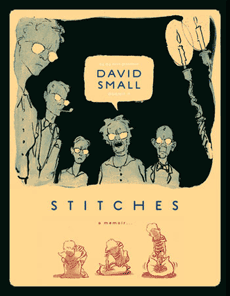
Small, David. Stiches. Norton, 2007. 14-18 yrs
“Mother coiled tight inside her shell of angry, resentful silence.” David Small’s tight, precise words set the stage as a backdrop to the emotionally-charged, often wordless images in his revealing graphic memoir, Stitches. Small’s signature black ink drawings softened by a gradation of black to gray watercolors as also seen in the popular National Book Award Finalist, The Underneath by Kathi Appelt (Atheneum, 2008) carefully expose a haunting darkness to the stories he illustrates. In Stiches, the audience sees first-hand where this darkness originated. Small’s mother had an undiagnosed mental illness causing her family to communicate in animalistic, word-less sounds: mom slams doors, dad takes it out on the punching bag, brother plays the drums. Small internalized the dysfunction by getting ill. His parents were not honest about the dire nature of his disease, which he finds out only through his own investigation, is cancer.
Children and young adults with cancer rarely find themselves depicted in popular literature formats such as the graphic novel. Small leads what is now an “issues” trend in young adult novels (re: cancer) but he does so without clichés, staying true to the origin story of how he got a scar from the stitches across his neck. This gritty honesty is a learning opportunity for young adults to creatively interpret their own emotional and physical scars. In an age of Photoshop and cosmetic surgery, it is extremely important to examine imperfections and how they transcend circumstances. Teachers and librarians could use Stitches as a book club selection or to launch a creative nonfiction writing workshop on the seen and unseen scars of childhood. One thing that kept Small going through his painful, early years was a healthy obsession with Alice’s Adventures in Wonderland and Through the Looking-glass (Lewis Carroll) which could serve as a highly accessible entry point for young people into the deep world of David Small.
##
This collection of unpublished literary reviews are Copyright, 2013, Mary Grace Maloney; images Copyright by Publisher and/or Artist.
 M.G. Maloney, MLIS